Im very excited to bring you an incredible species of gecko that I've always found to be very interesting. Also know as spider geckos, or Persian spider geckos, these lookers are indigenous to Afghanistan, Iran, as well as Pakistan. Their scraggly limbs allow them to navigate their rocky habitat, and are said to make them look similar to a spider, hence their common name. These geckos can be quite vocal, which is another characteristic I like in a gecko. I want to thank Laura Mansfield for the pictures, she is at www.goodlifeherps.weebly.com.
Here's a video of a male chirping/calling for a female:
Sorry for the delay in postings. Life can get hectic, but I will try to post a few a week until I am caught up....Öli
Cordylus cataphractus, also commonly known as the Girdled Armadillo lizard, is endemic to the Western coastal region of South Africa. They are known to reside in groups of numerous females, as well as numerous males. They live in rocky areas, and inhabit the tight crevices, and cracks between large boulders. Their diet consists of mostly insects, but it has been said that they will occasionally eat vegetative matter as well, but I have not witnessed this first hand. These lizards are covered in hard spines, and are plated with armor on their posterior. When threatened, they curl up into a ball, and bite their tail. At this point they are a spiny, and an armored loop shape which protects their soft belly. Sorry I don't have any pictures of this, but a quick google search on Cordylus cataphractus will display images of them in this position. Enjoy the pics!
Here's a little video I had posted some time back, but to properly commemorate this species I figured that I would re-post it for those of you that did not catch it the first time around.
This is a picture of an enclosure that house a group of these lizards
He is not to happy with me taking his picture
Commonly referred to as cone head lizard or serrated casque head iguana, these beautiful lizards are endemic to the tropical rainforest of southern Mexico, and Honduras. These lizards, as you can see from the photographs, have lanky limbs, and very long tails. They are an arboreal species of lizard that rarely goes down to the ground.
Hello folks, this week we bring to you the ever so popular Pachydactylus rangei. Commonly referred to as Namibian webfoot geckos, these smaller geckos make excellent captives. They do well on sand, and their webbed feet help them navigate through it with ease. Not only are they very cool looking, they also have a pleasant demeanor. They are unusually calm, and truly enjoy digging, and burrowing in sand. I keep my colony in groups of 1.3, and get great results in regards to breeding, and egg laying. A very prolific, and hardy species for sure. Females can lay 2 egg clutches every 3 weeks or so, and can easily lay 8 or more clutches per season, no problem. Enjoy......
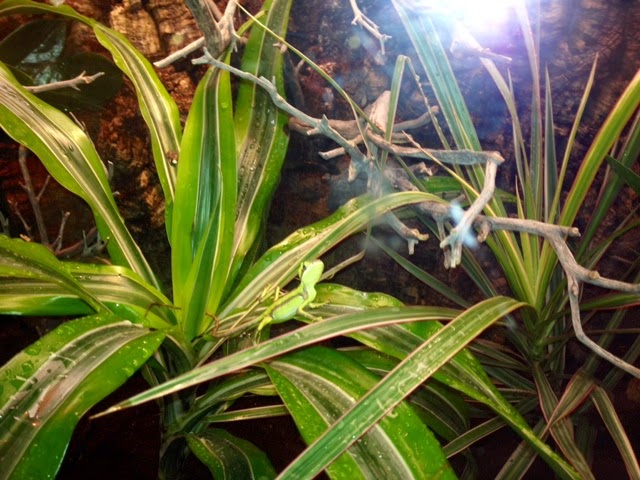
"Commonly" (a very relative term as they aren't commonly referred to at all) named the Green keel bellied lizard for all of you non Latin lovers (myself excluded there) are endemic to an Eastern portion of the African peninsula, Tanzania, as well as Kenya to be precise. They reside in the canopies of trees and therefore are not seen frequently, not only in the wild, but also in herp collections. Here are a few photos. Special thanks to Steve Cemelli from www.leapinleachies.com for the pictures taken without his knowledge :) enjoy! Here are some videos as well:
Here's the second vido, this guy recently finished eating a cricket. I tried to get a video of him eating, but it didn't go as planned. The video gives you a different perspective on the lizard none the less.
And here is a third video of them eating some prepared carniverous diet from a pair of tongs.
OK, thanks for tuning in everybody. I'm going to start the countdown with a velvet gecko species coming from Australia that was a very popular species in the hobby about 7 or so years back, but now I don't see many of these around at all. This is kind of sad because they are a brilliant gecko with stunning patterns and coloration. I had a small breeding group of these back when, so these pictures are a bit dated, but as you can see, they are brilliant geckos...Enjoy Oli
So, obviously, this is a totally opinion based blog publication, but I am not close minded towards your opinions on which species should be included in this list. So contact me in any way, email, facebook, text, etc. to throw your $0.02 in my direction. Granted the finite nature of this countdown, and the fact that I will be excluding the 52 species that were included in the 2010-2011 countdown, there can only be so many posts. I must say, that I am a bit biased towards species I have in my collection, because if I wasn't I wouldn't have acquired them. I will try my best to not only include pictures (as high quality as I could take, or obtain), but also video's. So the countdown will be not only of species that I keep, but those kept by others in the hobby, and credit will be given towards the individuals that help me out. That being said, I have created a video to hype you people up. I consider it as somewhat of a brief glimpse of what's in store. I apologize for the video's quality at times, YouTube removed some of the audio sections due to copy rite infringement. I apologize to the musicians that I have stolen from. I'm going to try and have some fun with this count down. Special thanks to all the organizations that fight for our right to keep these beautiful exotic animals. Please support them with whatever means you can do so, they are critical for the continuation of this hobby!!! Yours truly, Oli